
All natural numbers are born from unit by addition of itself. And all are equal in rights. But multiplication (and division) allocates from them numbers - diamonds (not having multipliers).
It is 2, 3, 5, 7, 11, 13, 17, 19, 23, 29, 31, 37, 39, etc.
To find the law of their distribution is a dream of mathematicians many
centuries (we shall recollect Eratosthenes's sieve). The theory of numbers - a
science which is not having any practical application while the cryptography has
not undertaken it is engaged in it.
Perhaps, the most powerful result was received still by Leonard Euler:
the number of primes which are not exceeding number N, is approximately equal to number N / ln (N).
I
have tried to investigate distances between the next primes, giving all
increasing intervals: primes up to thousand, up to ten thousand..., up to
billion (an insignificant share, in fact they leave in infinity  ). Clearly, that on the average distances grow. How to compare? And how we
compare a small photo and the big poster? - we bring it to uniform scale. At the
same time it would be desirable, that also the person was in one foreshortening.
). Clearly, that on the average distances grow. How to compare? And how we
compare a small photo and the big poster? - we bring it to uniform scale. At the
same time it would be desirable, that also the person was in one foreshortening.
 And in mathematical statistics there is a uniform scale: zero average and an
individual dispersion. And a foreshortening - we shall consider functions of
distribution.
And in mathematical statistics there is a uniform scale: zero average and an
individual dispersion. And a foreshortening - we shall consider functions of
distribution.
Here
it is visible, that step function of distribution comes nearer to a smooth curve
- standard Poisson's distribution. For the sake of scientism in a right column
it is shown, as difference between two curves in norm L2 decreases. Decreases,
but terribly slowly. 

Mathematics these schedules amaze, not mathematics are represented funny. In what the reason? - For mathematics primes - absolutely determined object, and Poisson's distribution characterizes set of casual independent processes. Both determined and casual appear connected! We shall formulate a hypothesis:
the distance between the next primes is distributedsimilarly to Poisson's law.
Whether these schedules the mathematical proof are - are not present.
What
it to hear applieds? Even the experiment basing on statistics from 50 million
847 thousand of 534 primes, proves nothing! But the mathematics of infinity is
those.
Even the schoolboy (but clever) is capable to specify a place in a natural line
where 50 million numbers are not prime successively!
The first idea - whether follows this result from Euler's theorem? It is unique, that is proved.
Let's
consider quaziprimes Ni, determined by a ratio i = Ni
/ ln( Ni ), i = 3, 4, ... One of characteristics of
function of distribution is camber (as at Poisson's distribution) or concavity
of the schedule. And so, for quaziprimes the schedule will be concave 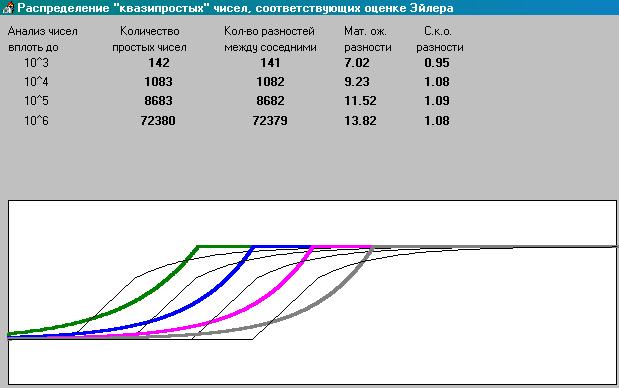
It is proved by research of 3-rd derivative function N( i ) - to return to function i = N / ln( N ).
Specificity of a hypothesis - that it does not segment as against the Big Pherma's theorem (cases N = 3, 4 ...).
