 Blue sites - there the solution is close to -1, red - the solution is
close to +1, yellow - a vicinity of zero, white - the radiation leaving
on infinity.
Blue sites - there the solution is close to -1, red - the solution is
close to +1, yellow - a vicinity of zero, white - the radiation leaving
on infinity.We research numerically the solution of the Cauchy problem for the following equation
d P( u )
( ∂tt - ∂xx ) u = -
────── ,
0 ≤ t < +∞
du
u( 0, x ) = u0( x );
∂t u( 0, x ) = v0( x )
u0( x ) → -1 at
x → -∞ ; u0(
x ) → b at x → +∞, b = ±1;
v0( x
) - finite;
P( u ) ≥ 0, P(
-1 ) = P( +1 ) = 0
Let's define density of energy
Then energy
+∞
E( t ) = ∫ r(
t, x
) * dx = Const
-∞
We receive the equation
d P( U )
( 1 - v2 ) * U'' =
──────
dU
Lowering
the order
( U' )2 = 2 * P( U ) /
( 1 - v2 )
On a phase plane two special points U = -1 and U = +1.
Separatrixes, connecting these points, describe kinks U' > 0 and antikinks
U' <
0.
Thus, there are two two-parametrical families for U( x - v* t
+ c ).
These solutions can be pushed together among themselves and to impose various
indignations.
We examined also classical potential P( u ) = 0.25 * ( u2 - 1 )2 and more difficult functions.
Typical picture of development of process: three kinks, having speeds +0.9; -0.4
and 0.0 collide among themselves, pass the friend through the friend and
continue a way already with speeds +0.88; +0.02 and -0.24.
Blue sites - there the solution is close to -1, red - the solution is
close to +1, yellow - a vicinity of zero, white - the radiation leaving
on infinity.
You can experiment with these calculations if will copy WinProg.zip and will choose entry conditions 3kinks_1.we1.
Small indignations blur (see entry conditions Dissip.we1)  ,
as corresponds to the linear theory.
,
as corresponds to the linear theory.
In case of three kinks we see, that after collision of speed approach. It is
natural to make the diagram of transition of speeds before collision and the
after.  And here we see unexpected - at close speeds kinks do not pass the friend
through the friend, and form steady oscillating solution (yellow area near to a
hypotenuse). Such solutions are called breathers.
And here we see unexpected - at close speeds kinks do not pass the friend
through the friend, and form steady oscillating solution (yellow area near to a
hypotenuse). Such solutions are called breathers.
Take for the program entry conditions Pot1_briz.we1 and you receive
breather  .
.
I.e. between dissipation area (the described by the linear theory), and area of strong collisions kinks (solutions such as "a running wave") are area of breathers - oscillating solutions with the steady frequency characteristic.
Not clear, how to prove their existence. They too big also are not subject to
the linear theory (on which they should not exist  ). They are not the solution of the ordinary differential equation as against
kink. How to them to steal up analytically?
). They are not the solution of the ordinary differential equation as against
kink. How to them to steal up analytically?
They with necessity arise at collision of the big number of kinks and
antikinks - since speeds approach. 
Breathers have different amplitude and energy (from 0.48 to 1.16), since as entry conditions we can take a pair more and more close to to each other kinks-antikinks.
But if this pair is sufficient shared from each other then always arises
breather with the maximal amplitude and energy, and same for the most different
pairs. Results of the spectral analysis of two breathers (the first - result of
collision of pair with speeds 0.2 and 0.0, the second - of pair 0.7
and 0.4) 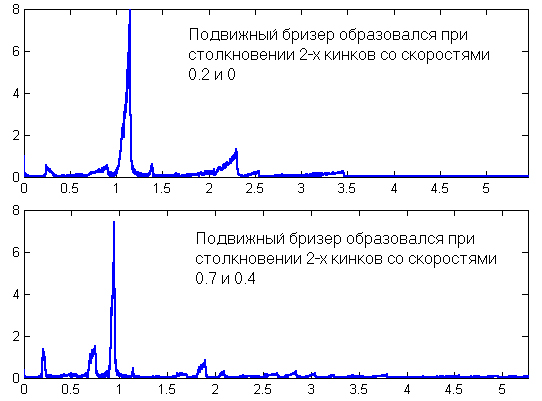 .
Displacement of frequencies is causing by the way of measurement: values in the
center breather through equal intervals of time were fixed. But faster breathers for
same time will pass both the greater distance and frequency will go down.
.
Displacement of frequencies is causing by the way of measurement: values in the
center breather through equal intervals of time were fixed. But faster breathers for
same time will pass both the greater distance and frequency will go down.
